Turkish Dried Apricots from Malatya – Product Specifications
Mirsan Gıda supplies Turkish dried apricots from Malatya in different grades, sizes, and product specifications. The following information provides general technical specifications for our dried apricot products. Final specifications may vary according to product grade, customer requirements, and destination-country regulations.
Product Information
| Specification | Details |
|---|---|
| Product | Dried Apricots |
| Origin | Malatya, Turkey |
| Product Type | Whole, pitted dried apricots |
| Grades | Extra, Class 1, Class 2 |
| Natural Variety | Sun / Natural Dried Apricots |
| Sulphured Variety | Sulphured Dried Apricots |
| HTS Code | 0813.10.00.00.00 |
Product Description
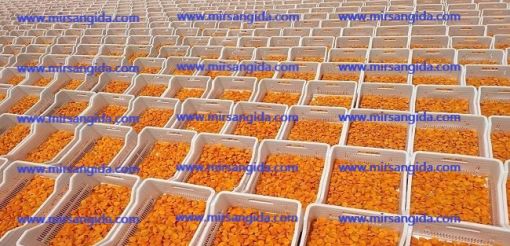
Dried apricots are produced from ripe apricots that are selected, processed, pitted, and dried.
Depending on the product type, apricots may be naturally sun dried or treated with sulfur dioxide to help maintain their characteristic color and product stability.
Before packaging, the product is sorted and graded according to relevant quality specifications. Additional processing and quality controls may be applied according to product type and customer requirements.
Critical Product Characteristics
Moisture
Typical specification: 18–25% moisture; maximum 25%.
Sulfur Dioxide (SO₂)
1,800–3,500 ppm for sulphured products, subject to product specification, customer requirements, and applicable destination-country regulations.
Grades of Turkish Dried Apricots
| Grade | General Classification |
|---|---|
| Extra | Higher-grade product with stricter defect tolerances |
| Class 1 | Standard commercial quality |
| Class 2 | Product with higher permitted defect tolerances |
| Industrial | Intended primarily for food manufacturing and industrial applications |
Physical Requirements
| Defect | Extra | Class 1 | Class 2 | Industrial | Class 1 Natural |
|---|---|---|---|---|---|
| Dirty fruit (%) | 4 | 6 | 12 | — | 10 |
| Undeveloped fruit (%) | 1 | 2 | 4 | — | 2 |
| Spotted fruit (%) | 3 | 4 | 6 | — | 6 |
| Hail marks / Sunburn (%) | 3 | 5 | 10 | — | 6 |
| Discoloration / White spots (%) | 2 | 4 | 8 | — | 6 |
| Damage / Cuts (%) | 4 | 6 | 12 | — | 12 |
| Wormy fruit (%) | 0 | 1 | 4 | — | 1 |
| Mouldy fruit (%) | 0 | 1 | 2 | — | 1 |
| Fermented / Deteriorated (%) | 0 | 0 | 2 | — | 0 |
| Pit / Pit fragments (pcs/box) | 1 | 1 | 2 | — | 1 |
| Foreign material (pcs/box) | 0 | 0 | 0 | 0.5 | 0 |
Organoleptic Requirements
| Criteria | Requirement | Method |
|---|---|---|
| Color | Typical for the product type | Visual |
| Flavor / Odor | Typical of dried apricots and free from objectionable odors | Sensory evaluation |
Chemical Requirements
| Parameter | Specification | Method |
|---|---|---|
| Moisture | 18–25%* | AOAC 90 |
| SO₂ Content | 1,800–3,500 ppm* | TS 8131 |
*Final specifications may vary according to product type, customer requirements, and applicable regulations.
Nutrition Information (per 100g)
| Nutrient | Amount |
|---|---|
| Energy | 294 kcal |
| Protein | 3.61 g |
| Carbohydrate | 66.5 g |
| Vitamin B1 | 0.1 mg |
| Vitamin B2 | 0.16 mg |
| Vitamin C | 12 mg |
| Calcium | 22 mg |
| Iron | 3.88 mg |
| Sodium | 1.25 mg |
| Potassium | 1269 mg |
| Phosphorus | 108 mg |
| Magnesium | 47.8 mg |
| Carotene | 2.5 mg |
| Niacin | 2.81 mg |
Packaging
Standard packaging is available in corrugated carton boxes with a net weight of 12.5 kg per carton. Packaging can be customized according to customer requirements.
Depending on the product and order requirements, packaging formats can range from 100 g to 12.5 kg.
Labeling
Product labeling may include:
- Product name
- Brand
- Manufacturing date
- Expiration date
- Net and gross weight
- Ingredients
- Manufacturer name & address
- Country of origin
- Batch number
- Nutritional information
- Target market compliance requirements
Storage & Shelf Life
Dried apricots should be stored in a clean, dry, and cool environment according to the applicable product specification.
Shelf life: 12 months from the date of production when stored under the specified storage conditions.
Dried Apricot Processing at Mirsan Gıda
At Mirsan Gıda, dried apricots are processed through controlled washing, drying, sizing, sorting, and quality control stages. Our processing procedures are designed to maintain product quality, hygiene, and consistency from incoming raw material to final packaging.
- Purchasing & Quality Control: Inspection and acceptance testing of raw apricots.
- Initial Washing: Pressurized water washing to remove surface impurities.
- Precision Washing: Secondary washing with potable drinking water.
- Initial Drying: High-pressure air fan moisture reduction.
- Sizing & Grading: Separation into size categories (No. 1 to No. 8).
- Initial Sorting: Physical defect separation.
- Final Sorting: Final detailed inspection by trained personnel.
- Laboratory & Quality Control: Testing for moisture, SO₂ levels, and foreign materials.
- Drying & Conditioning: Controlled drying to reach target moisture specifications.
- Final Quality Control: Pre-packaging specification checks.
- Packaging & Cartoning: Hygienic packaging (100 g to 12.5 kg options).
Explore Our Turkish Dried Apricot Products
- Turkish Dried Apricots from Malatya
- Sulphured Dried Apricots
- Mirsan Gıda – Turkish Dried Apricot Exporter
Our Facility and Products
.jpg)
.jpg)

